
Statement of Purpose (SOP): Format, Tips & Sample for Study Abroad
The Statement of Purpose (SOP) is one of the most important aspects when attempting to impress the admissions committee when applying for grad school. This document explains why you love your chosen field and how well you fit the program you are applying to.
- 1.What is a Statement of Purpose (SOP)?
- 2.Why is a Statement of Purpose Important?
- 3.How to Write a Statement of Purpose (Step-by-Step)
- 4.SOP Format for Study Abroad (2026)
- 5.Difference Between Personal Statement and SOP
- 6.Types of SOP Introduction
- 7.SOP Introduction Sample
- 8.What to Include in the SOP Body
- 9.How to Write a Strong SOP Conclusion
- 10.Common SOP Mistakes to Avoid
- 11.Ideal SOP Word Limit
- 12.Essential Tips for Writing an Impressive SOP
- 13.Get Expert Help for Your SOP
- 14.FAQs
Regarding the SOP as your opportunity to express yourself to the college you want to be admitted to. Along with your accomplishments, you must show why you are a good match for the program by sharing your interests, goals, and aspirations.
What is a Statement of Purpose (SOP)?
A Statement of Purpose (SOP) is a formal essay required for university admissions that explains a student’s academic background, career goals, and reasons for choosing a specific program. It helps admission committees evaluate a candidate’s potential beyond academic scores.
Why is a Statement of Purpose Important?
Simply put, the SOP is an avenue for you to impress the admission committee and explain why you deserve the opportunity to pursue higher education.
Book Free Counselling Session
- It highlights your academic journey and achievements
- It reflects your personality and motivation
- It explains your career goals and ambitions
- It increases your chances of admission and scholarships
While you are sharing facts, your SOP is also about storytelling—your journey so far, your aspirations, and why you chose a particular career path.
How to Write a Statement of Purpose (Step-by-Step)
Drafting a Statement of Purpose (SOP) gives universities a complete view of your personality beyond academic records.
Follow these steps:
- Start with a strong introduction
- Explain your academic background clearly
- Highlight your projects, research, and experience
- Showcase your skills and achievements
- Define your career goals
- Explain why you chose this program/university
- Conclude with clarity and confidence
Students with modest academic records can still stand out with a well-written SOP that clearly communicates their goals and strengths.
SOP Format for Study Abroad (2026)
- Introduction: Your story and motivation
- Academic Background: Education and achievements
- Experience: Projects, internships, research
- Skills: Technical and soft skills
- Career Goals: Short-term and long-term
- Why This Program: University alignment
- Conclusion: Summary and future vision
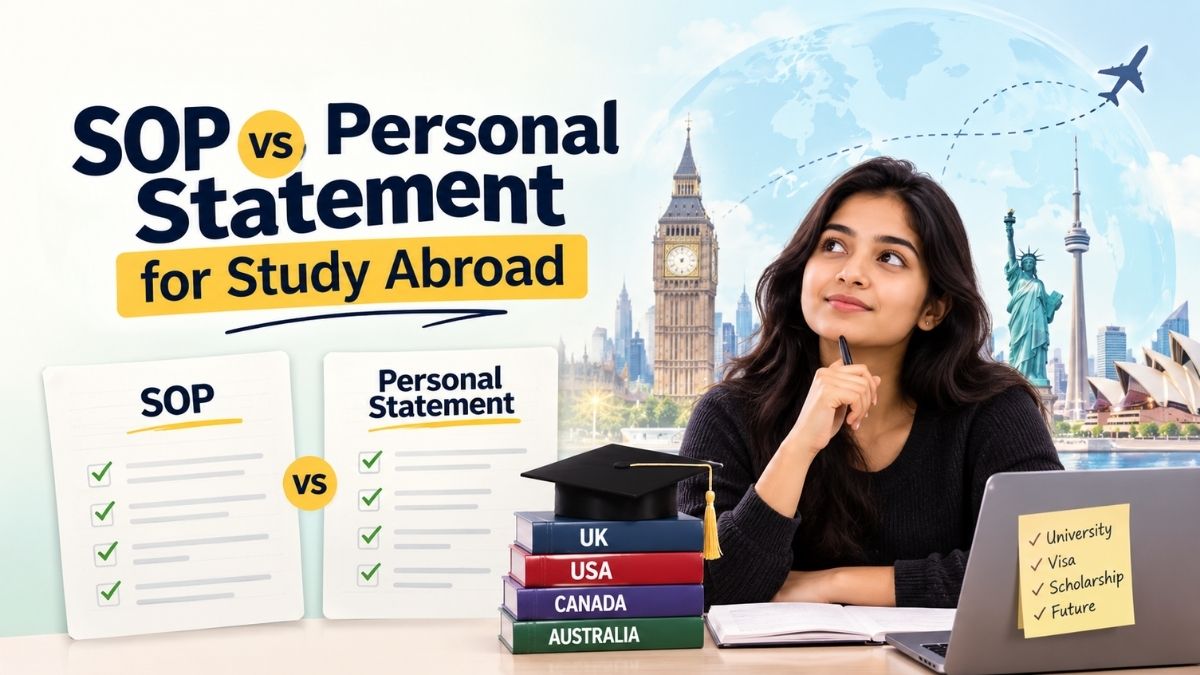
Difference Between Personal Statement and SOP
Personal Statement
A personal statement is a reflective narrative combining personal, academic, and professional experiences. It focuses more on individuality, passion, and personal motivations rather than detailed academic or research goals.
Statement of Purpose
A Statement of Purpose (SOP) is a structured essay that focuses on academic background, research interests, career aspirations, and program alignment. It clearly explains your goals and future direction.
Types of SOP Introduction
1. Incident-Focused Introduction
This approach starts with a real-life incident that sparked your interest in the field and shaped your academic journey.
2. Comprehensive (Summary-Based) Introduction
This approach provides a quick overview of your academic background, experiences, and motivation for higher education.
3. Quote-Driven Introduction
This approach begins with a meaningful quote that reflects your values and connects it to your journey.
SOP Introduction Sample
Sample: 1
“My journey into computer science started during my first year of college. I encountered a tough assignment with a tight deadline, pushing me to find creative solutions. This experience sparked my interest in the incredible potential of computer science for solving real-world problems. Over time, I became more focused on Data Science, partly due to my coursework and projects. In today’s digital world, data is everywhere, offering opportunities for innovative solutions. As such, I am passionate about using data to make a positive impact and create new inventions.”
Sample: 2
“I find programming as a field that is both fascinating and exacting which requires employing creativity, imagination, and, at the same time, a problem-solving attitude. My love for mathematics originally drove me to computer science and I was thrilled with its inherent logic and freedom of the roof framework. This fascination of mine has been a striking feature of my educational development, influencing me from my early school years through my undergraduate. While my undergraduate program taught me a lot, it was indeed when I started looking toward higher education that I started to feel enthusiastic about Artificial Intelligence (AI). With the understanding of the foundation of programming principles and algorithms behind me, I feel confident to explore and further the computer science world.
Sample: 3
“No matter the difficulties that we encounter, it is vital to support one another in building a community forever. And therefore this quote by Helen Keller best describes how I conduct my activities. This remark reflected exactly my feelings, though I suppose it is obvious since we speak about teamwork and communication. I saw the real power of teamwork in both being a student and working so that many goals can be reached and people apprise themselves. I learned how a set of attributes and approaches could be blended (during group projects as well as live operations, which were quite insightful to me) to get standardized and top-notch solutions.”
What to Include in the SOP Body
When writing the body of your SOP, include the following:
- Educational Background: Key subjects and achievements
- Projects and Research: Work that showcases your skills
- Internships and Experience: Practical exposure
- Skills Development: Technical and soft skills
- Interdisciplinary Learning: Connections across fields
- Career Goals: Future aspirations and clarity
Writing about yourself becomes effective when you clearly understand your academic journey and key turning points that shaped your decisions.
How to Write a Strong SOP Conclusion
- Reiterate your passion for the field
- Clearly define your career goals
- Highlight relevant experiences
- Show alignment with the university
- End with confidence and gratitude
Common SOP Mistakes to Avoid
- Copying content or using generic statements
- Lack of clarity in goals
- Poor grammar and structure
- Writing overly long or irrelevant content
- Not aligning with the university
Ideal SOP Word Limit
- General SOP: 800–1000 words
- MBA SOP: 1000–1200 words
- MS SOP: 800–1000 words
Essential Tips for Writing an Impressive SOP
To ensure your SOP stands out:
- Be honest and genuine
- Use a confident and positive tone
- Support your points with real examples
- Maintain clarity and logical flow
- Show resilience when discussing challenges
Even if you mention difficulties (financial, academic, or personal), present them positively by highlighting your growth and determination.
Get Expert Help for Your SOP
For more personalized guidance, students can benefit from expert counselling support. Professional guidance can help you craft a strong, structured, and impactful SOP that improves your chances of admission.
FAQs
Yes, a strong SOP can significantly improve your chances by clearly presenting your achievements, goals, and motivation.
Generally, SOPs do not require certification, but some institutions may have specific requirements.
Yes, internships showcase practical experience and strengthen your profile.
Yes, but present them positively by explaining how you overcame them and what you learned.

Kanishka Garg
Kanishka Garg specializes in crafting informative content on study abroad education. Her passion lies in simplifying the journey for students through SEO-optimized articles and blogs. Kanishka's commitment to clear communication and her deep understanding of international admissions processes make her blogs essential for students aiming to gain insights into top universities worldwide. With Kanishka's blogs, students can confidently get solutions to the complexities of applying to their dream universities and achieve their academic aspirations abroad.