

Study in Ireland Vs UK 2026: Complete Comparison

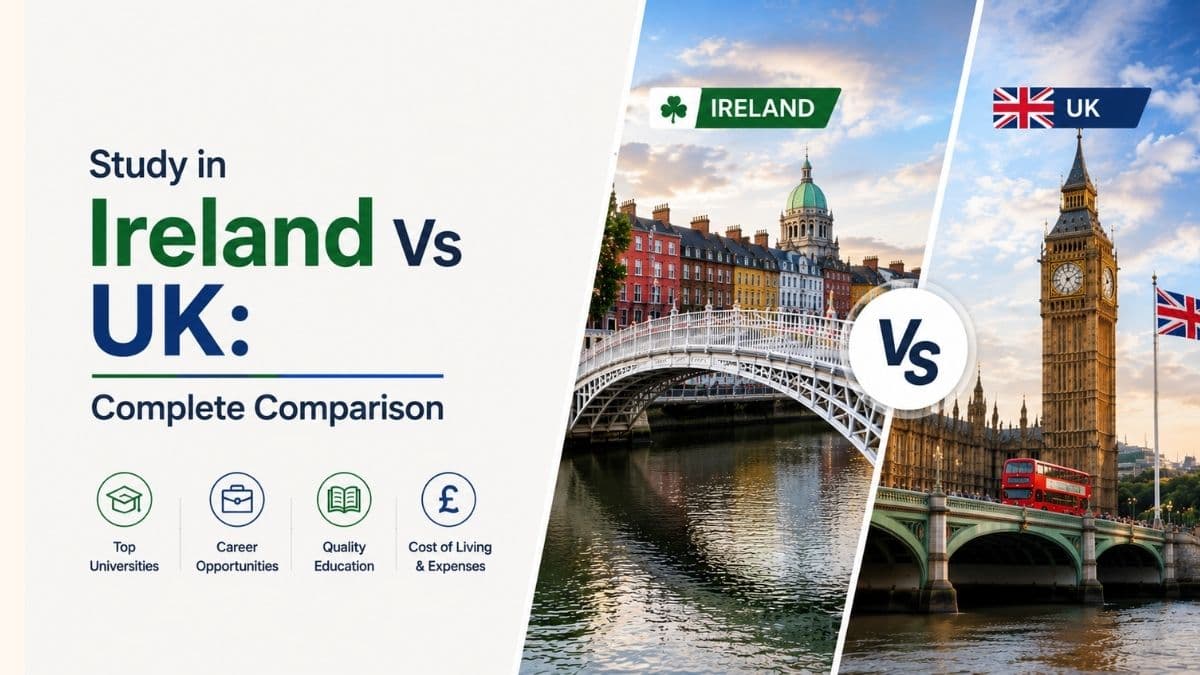
Choosing to pursue your international degree plays a huge role in mapping your career pathway. For most international students, the UK is the go-to place when it comes to study abroad decisions. Ireland, on the other hand, is an emerging destination for foreign education aspirants, which brings one to the comparison: study in Ireland vs UK. There are multiple aspects that you must check and compare before making that final decision.
- 1.Key Highlights – Study In Ireland Vs UK
- 2.Ireland Vs UK – The Direct Comparison
- 3.Tuition Fees And Cost Of Living For International Students
- 4.Visa Requirements – Ireland Vs UK For International Students
- 5.Career Outcomes By Sector – For International Students
- 6.Choose the UK If You:
- 7.Choose Ireland If You:
- 8.Which Country Should You Choose?
- 9.Conclusion
- 10.FAQs
If you’re looking for lower overall costs, a strong tech ecosystem, and access to the European job market, Ireland may be the better choice. If you want more university options, globally renowned institutions, and wider career opportunities in finance, consulting, and engineering, the UK could be the ideal destination.
Those students who wish to weigh the pros and cons of study in Ireland vs UK, will find the UK job market to be expansive. However, Ireland scores high on the tuition costs and cost of living front. Additionally, Ireland gives students direct entry into the European job market. You will find the world’s top universities in the UK, while Ireland has eight main universities, topped by Trinity College Dublin and University College Dublin.
In this blog, we aim to unearth costs, post-study visa, eligibility, admission process, and work opportunities offered by the two places.
So, let us get started.
Key Highlights – Study In Ireland Vs UK
At Admissify, we’ve counselled thousands of Indian students choosing between Ireland and the UK. Students targeting careers in technology, data science, and pharmaceuticals often prefer Ireland, while those aiming for finance, consulting, management, and engineering usually choose the UK due to its wider employer network and university options.
| UK | Ireland |
| The UK is a much larger destination for study abroad aspirants, with almost 146,000 Indian students holding UK study visas | Ireland has around 9,000–12,000 Indian students holding student visas |
| The UK Graduate Route Visa tenure drops to 18 months from 2027 | For Master’s (NFQ 9+) students, the tenure is 2 years for post-study visa |
| Cost of Living expenses hover around £13,347 – £10,224 | Living costs hover around €10,000 |
| UK visa fee rises to £937 | Ireland visa fee is €60. |
So, the question most International students keep asking today is Ireland or the UK. Top study abroad consultants face this question every time a student walks in.
Ireland Vs UK – The Direct Comparison
So, we will quickly get down to a quick comparison between studying in Ireland and study in UK.
| Particulars | Ireland | UK |
| No. of Study Visas Issued Currently | 9,000–12,000 | 146,000 |
| Tuition Fee For MSc. | €15,000–€30,000 | £14,000–£32,000 |
| Course Duration | 1 year | 1 year |
| Cost of Living | €10,000 | £13,347 – £10,224 |
| Health surcharge | Nil | IHS £1,035 per year of stay |
| Visa Application Fee | €60 | £937 |
| Part-time Working Hours For Students | 20 hours/week during term & 40 hours/week during vacation | 20 hours/week during term & 40 hours/week during vacation |
| Visa Acceptance Rate For Indians | 95–96% | 95–97% |
| Intakes Timelines | October–June for September intake | September–May for September intake |
| Top Courses | IT, Pharma, Finance, Med-tech, Fintech | Many |
This is just an average representation of what Indian students can expect while deciding to study abroad. You will get more clarity only when you consult a study abroad expert.
Choose Ireland if your priorities are lower living costs, longer post-study work opportunities, and careers in tech or pharma. Choose the UK if you’re looking for more university choices, stronger finance and consulting opportunities, and access to one of the world’s largest graduate job markets.
Tuition Fees And Cost Of Living For International Students
| Expense Head | Ireland | UK |
| Tuition (MSc at Public University) | €15,000–€25,000 per year | £14,000–£25,000 per year |
| Tuition (MBA at Top Schools) | €20,000–€35,000 | £25,000–£55,000 |
| Living costs | €10,000 per year | £13,347 – £10,224 |
| 1-year total (tuition + living) | €30,000–€45,000 | £28,000–£45,000 |
Pro Tip: Many Indian students reduce their overall study costs by choosing cities such as Cork, Galway, Leicester, Birmingham, or Sheffield instead of Dublin or London. Living expenses in these cities are generally more affordable while still offering quality education and career opportunities.
Visa Requirements – Ireland Vs UK For International Students
While applying for an Irish student visa, you need to fulfil the following conditions.
- You must maintain €10,000 in liquid bank funds.
- You are required to submit a 6-month bank statement.
- Your family member or friend can sponsor your stay.
- If you have taken an educational loan, the documents have to be submitted.
For the UK visa, you must fulfil the following.
- You should be able to spend at least £13,347 in London or £10,224 in the rest of the UK.
- You need to produce a bank statement of 28 continuous days, along with a closing balance which is not more than 31 days old, on application.
- Parents and legal guardians can be sponsors.
- Educational loan documents from regulated financial institutions only.
Expert Tips: For Ireland, Indian students must move funds into a savings account 6 months before applying.
Which Visa Process is Easier?
Both Ireland and the UK have transparent student visa processes. As long as applicants provide genuine financial documents, meet English language requirements, and submit complete applications, visa approval rates remain high for Indian students.
Career Outcomes By Sector – For International Students
| Sector / Industry | Ireland | UK |
| Software engineering | Google, Meta, Microsoft Starting salary – €48,000–€58,000 | Amazon, Google London, Bloomberg Starting salary – £40,000–£55,000 |
| Data Science / AI | Strong opportunities in pharma or financeStarting salary – €50,000 –€58,000 | Deep research at places like DeepMindStarting salary – £45,000 –£65,000 |
| Pharma / Med-tech | Sanofi, Stryker, Boston ScientificStarting salary – €40,000–€52,000 | AstraZeneca, BMS UKStarting salary – £35,000–£48,000 |
| Finance / Banking | Bank of Ireland, AIBStarting salary – €40,000–€50,000 | HSBC, Barclays, JP Morgan London, Goldman, Morgan StanleyStarting salary – £45,000–£75,000 |
| Engineering | Limited optionsStarting salary – €38,000–€50,000 | Rolls-Royce, BAEStarting salary – £32,000–£45,000. |
So, you must have understood by now that Ireland has a strong tech presence. Pharma and nursing are also amongst the top 20 worldwide. The UK is stronger in finance, banking, and engineering.
Which Country Offers Better Jobs?
There isn’t a one-size-fits-all answer. Ireland offers excellent opportunities in technology, pharmaceuticals, and med-tech, while the UK remains a preferred destination for finance, banking, consulting, law, engineering, and creative industries.
Choose the UK If You:
- Want a high-flying career in finance and management.
- Want to access the Russell Group.
- Want access to a vast community of Indian students.
- Want to choose from a wide range of subjects and specialisations.
- Comfortable with the 18-month Graduate Route Visa.
Choose Ireland If You:
- Want a career in Pharma, med-tech, or nursing.
- Want a longer post-study visa.
- Want to save on the IHS costs.
- Want a clear pathway to the European Union labour market.
- You are not OK with the Skilled Worker B2 English, RQF Level 6 and £41,700 salary threshold for post-Graduate-Route conversion.
Which Country Should You Choose?
| Choose Ireland If | Choose UK If |
|---|---|
| You want lower overall costs | You want more university choices |
| Tech is your preferred career | Finance is your preferred career |
| You prefer a smaller country | You prefer a larger job market |
| You want EU exposure | You want the Russell Group universities |
There is no universal winner in the comparison of study in Ireland vs UK. The right destination depends on your academic background, career goals, budget, and preferred industry. Before making a decision, compare universities, total expenses, scholarship opportunities, and post-study work options rather than relying solely on rankings.
Conclusion
Thus, you have understood the pros and cons of each country. The study in Ireland vs UK dilemma seems to be getting easier to come to terms with. You have to see what you aim for, and which sector you prefer. Then take the final decision. You can also consult Admissify, the best in study abroad consulting. Get end-to-end assistance in deciding on the subject, specialisations, universities, scholarship application and visa application.
FAQs
Yes, Ireland is cheaper, as you save on HIS costs and rent costs. The visa fee is also lower.
Yes, it is effective from 2027.
Ireland is more lenient than the UK. Parents can fund both studies in Ireland and the UK.
Rejections mainly occur due to lack of funds, document mismatch and missing deadlines. Otherwise, both countries have a high visa acceptance rate.
Yes, you can work 40 hours during vacations.

Abhrajita
Abhrajita Mondal is a content writer with over five years of experience in education-focused content. With 10+ years of corporate HR experience, she brings practical insights into career development, learning pathways, and student guidance. She specializes in creating clear, well-researched content on education, career planning, and related topics, helping readers make informed and confident decisions.