
France’s Fast-Track Citizenship Pathway for International Students

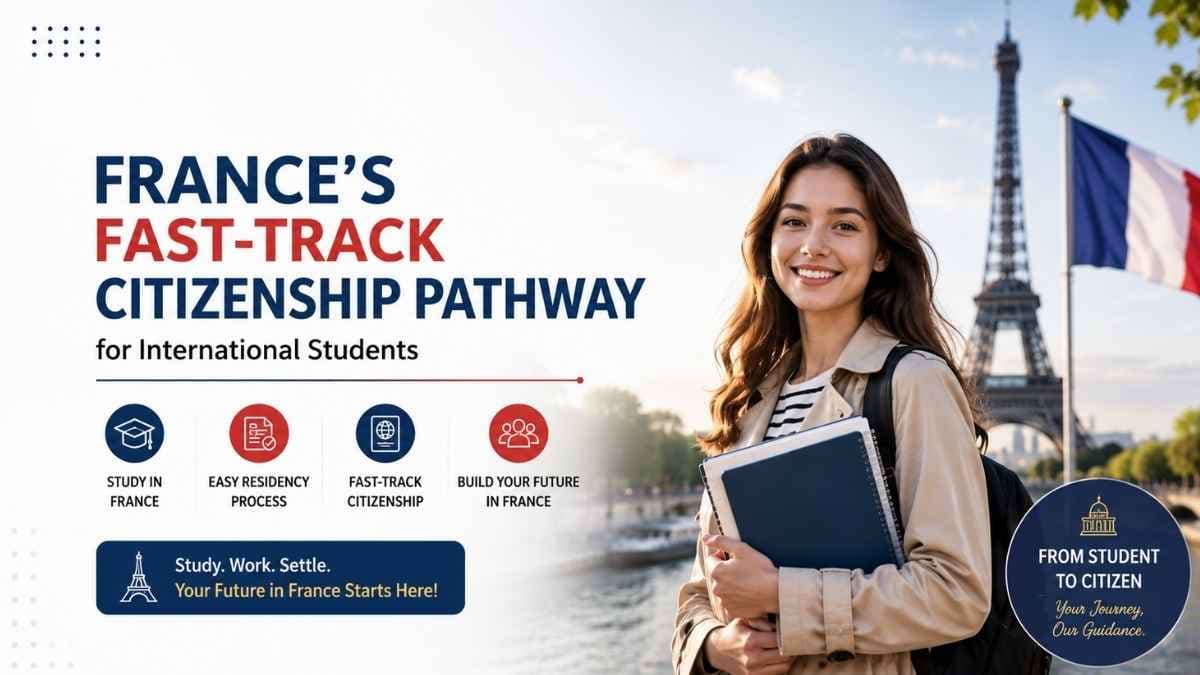
France grants citizenship by naturalisation after five years of continuous, habitual residence. That rule is well-known. What is less widely understood, particularly among international students, is that two of the three statutory exceptions to that five-year requirement are directly accessible through the French education system.
- 1.Can international students get French citizenship faster than the standard five years?
- 2.The Standard Five-Year Rule and why it applies to most migrants.
- 3.The Two-Year Fast Track for Students Who Study in France
- 4.The meaning of “Successfully Completed” in practice
- 5.The Talent Visa Route: Two Years for Exceptional Contribution
- 6.How the Student Route and Talent Route Intersect
- 7.Core Eligibility Requirements for Naturalisation
- 8.The Application Process
- 9.What Citizenship Grants That Residence Alone Does Not
For students who plan, the pathway from enrolment to citizenship can be significantly compressed.
Can international students get French citizenship faster than the standard five years?
Yes. Under Article 21-18 of the French Civil Code, foreign nationals who complete at least two years of higher education at a French institution and obtain a French diploma qualify for a reduced residency requirement of two years. Separate accelerated routes exist for Talent visa holders and those who render exceptional services to France.
The Standard Five-Year Rule and why it applies to most migrants.
According to Article 21-17 of the Civil Code, naturalisation by decree is based on the proof of 5 years of continuous residence in France before the application. Residence should be personal, effective, legal and continuous. The French Council of State is very attentive to this requirement: the centre of material and family interests of the applicant must be “stably” established in France during the period.
A short absence from France will not prevent an applicant from being considered, but an absence of more than one year may interrupt the probationary period. Students who have participated in a formal exchange programme with their institution are not subject to deductions for absences during the exchange period, and this is an exception.
This five-year rule is applicable to the vast majority of third-country nationals, including graduates of foreign universities who come to France following graduation from other universities.
The Two-Year Fast Track for Students Who Study in France
What Article 21-18 Provides
Article 21-18 of the Civil Code creates three distinct circumstances under which the five-year probationary period is reduced to two years. The first, and most directly relevant to international students, applies to:
- A foreign national who has completed two years of higher education to acquire a diploma issued by a French university or higher education institution.
This is not a discretionary accommodation. It is a codified statutory reduction. A student who completes a Master’s degree at a French institution, for example, satisfies this condition.
Upon completing the programme, they need only an additional two years of legal residence before becoming eligible to apply for naturalisation.
The meaning of “Successfully Completed” in practice
The condition requires actual completion of the programme and award of a French diploma. Partial completion is not acceptable. This is not a suitable basis for a student who is currently enrolled but not yet graduated. There is no provision for the assessment of qualifications in progress.
The diploma should be from a French institution. The Article 21-18 criterion is not met by degrees from foreign universities, even with a French partnership or dual degree with the main awarding university abroad.
The Two Additional Years Still Count
The probationary period is not reduced to two years if you apply immediately after graduation. The two years of post-graduation residence must be of the same standard as the five years. Income should come from a regular job or a regular activity in France. Family connections have to be made in the country.
If a student leaves France and goes back to their home country for a long period of time, and then returns to France, they will not be able to count the residence of the study period in the home country towards the post-graduation requirement without the risk of being challenged.
The Talent Visa Route: Two Years for Exceptional Contribution
The second exception to Article 21-18 is for foreign nationals who have provided (or can provide) important services to France. A May 2025 circular from the French Ministry of the Interior clarified how this provision applies to Talent visa holders.
Foreign nationals who are on a Talent visa and are employed in an intellectual, cultural, scientific, innovative or sporting field can apply for citizenship after two years of residence if they can prove:
- A minimum of B2 level of French language skills (above the standard B1 requirement)
- Stable income, mainly from activities in France
- Successful integration into the professional and cultural world of France
Some of the subcategories of talent visa include Chercheur (researcher), Artiste, Innovateur, Entrepreneur, etc. In practice, this pathway is used most frequently by researchers, scientists, artists and specialists engaged in innovative projects funded by the government.
How the Student Route and Talent Route Intersect
A student who has finished a Master’s or doctoral programme in France and then switched to a Talent visa can apply for the two-year visa on both grounds — or both at the same time. The Article 21-18 student exception only requires the French diploma and two years of residence in France, without a Talent visa. The Talent visa route requires a higher level of French language skills, professional recognition and contribution to France’s prestige.
The Talent visa offers a better application profile for students in research, technology or the arts and is becoming the most popular visa to apply for.
Core Eligibility Requirements for Naturalisation
Regardless of which pathway applies, all applicants for French citizenship by decree must satisfy the same substantive conditions.
- French Language Proficiency
The current minimum is B1 oral and written French (diploma or certificate from a recognised institution, e.g. DELF, TCF, TEF). From 1 April 2020, both oral and written B1 are required for applications made. The minimum standard will be increased to B2 from 2026. The B2 requirement is already in place for applicants applying for the Talent visa fast track.
The French Office for Immigration and Integration (OFII) offers free French language courses from A1 to B1.
- Assimilation Interview
All naturalisation applicants are interviewed by a prefect official. The aim is to evaluate the assimilation into the French community, including knowledge of French history, culture and civic life, understanding of the rights and duties of French citizenship, and respect for the values of the Republic. The Charter of Rights and Duties of the French Citizen is signed by the applicants at the end of the interview.
- Financial Stability
Applicants must have a regular and legal income, mainly from employment or activity in France. This does not apply to income from outside France, unless it is from a stable profession in France. The general guideline is to earn the same or more than the French minimum wage (SMIC), which was around €21,621 gross per year in 2025. The main evidence consists of tax returns, employment contracts, and payslips from the previous years.
- Good Character
Articles 21-23 of the Civil Code prohibit the naturalisation of applicants who are not of good character. An application is not admissible if the sentence is not suspended or the sentence is suspended for less than six months. Authorities carry out administrative investigations, such as criminal records checks in France and other countries the applicant has lived in.
- Valid Residence Permit
Applicants should have a valid residence permit at the time of application. The applicant must also be resident in France at the time of the signing of the naturalisation decree (Article 21-16 of the Civil Code).
The Application Process
Applications are made to the prefect of the applicant’s residence (or, for those living outside France, the French consulate). When a complete file is received, it will result in a receipt that will indicate the processing deadline. The application is then followed by a safety investigation, an assimilation interview, and a review by the Prefect and the Sub-Directorate of Access to French Citizenship (SDANF). The naturalisation decree is issued by the Prime Minister.
Under the law, the process has to be finished within 18 months of receipt of a complete file, with a possible extension of three months. This is lowered to 12 months for the applicants who have been living in France for 10 years. As of now, the process takes approximately 315 days for approved applications. The average processing time for rejected applications is about 148 days.
The application fee is €55. No refunds are available in case of failure of the application.
What Citizenship Grants That Residence Alone Does Not
French citizenship gives full political rights: the right to vote, to be elected and to enter public service by competitive examination. It also grants EU citizenship (freedom of movement and residence within all member states of the EU, and the right to vote in elections to the European Parliament).
There is no requirement for renunciation of a former nationality in France. Full dual citizenship is allowed. Once the applicant has acquired French citizenship, he or she must inform the competent authority of the other nationalities he or she wishes to keep in addition to French nationality, but not of the renunciation of the other nationalities.
Does completing a two-year Master’s programme in France immediately qualify me to apply for citizenship?
No. The degree is a condition for a reduced period of two years of legal and effective residence in France, but this period must be completed after the degree is obtained, before applying.
Can I count my years of study in France toward the two-year post-graduation period?
No. The two-year probationary period starts once the diploma is awarded. Study years are not counted in the sense that they decrease the two-year requirement for post-graduation legal residence, but they may be counted for other purposes in the application.
Is B1 French sufficient for the fast-track student route?
The minimum standard now for naturalisation is B1 (oral and written). The B2 is a requirement for the Talent visa fast-track. For students who apply for the student exception under Article 21-18 prior to the change date of 2026, it is recommended that they apply for B2 to prevent delays if their application is processed after the change date.
Can a student who completed their degree outside France use the fast-track route?
No. The student exception in Article 21-18 explicitly calls for a diploma from a French university or higher education institution. Foreign degrees, such as joint degrees, are not accepted, except those obtained from institutions where the primary degree is awarded in French.

Bhaskarjyoti Paul
Bhaskarjyoti Paul is a content writer specializing in study abroad and international education. He creates clear, well-researched content on universities, admissions, scholarships, and student visas. Blending strategy with storytelling, he focuses on simplifying complex topics and delivering meaningful insights that help students make informed academic and career decisions while navigating global education opportunities with confidence.